WhatsApp voice notes: Love them or hate them? Let’s settle the debate.
Voice messages: some people swear by them, others wish they’d disappear forever. They’re quick to send, super personal, and often easier than typing, but they also come with a few drawbacks, especially when you can’t listen to them right away. Love them or loathe them, voice messages definitely spark strong opinions. So where do you stand?


In this blog article...
✓ The benefits of using voice messages
✓ Why the complaints about voice messages aren’t wrong
✓ No time to listen? How to convert voice messages to text
✓ How to record and send WhatsApp voice messages
✓ Conclusion: Are voice messages worth it?
Some people fire off three 15-second voice messages in a row, while others deliver a full seven-minute podcast episode in a single go. Voice messages come in all shapes and sizes, but are they really as practical as they’re made out to be? Or would a simple text or quick call sometimes do the job better?
Fans argue that voice messages are “faster” and “more convenient.” Maybe that’s true… or maybe we have all just become a little lazy when it comes to typing.
One thing is certain: voice messages have carved out a firm place in everyday communication on apps like WhatsApp. For some, they’re a fun and effortless way to stay in touch; for others, they’re a tiny digital nuisance that sparks big feelings.
The benefits of using WhatsApp voice messages
Voice messages deserve credit for at least one thing: they’re one of the quickest and most widely used ways to communicate today. But what exactly makes them so popular?Faster: A clear advantage for the sender
Multitasking has become part of everyday life, and this is where the voice message on WhatsApp truly shines. A quick WhatsApp voice recording can be created while walking, cooking, or juggling other tasks; no need to stop and type. From the sender’s perspective, it often feels like the fastest way to share thoughts.But then comes the moment of truth: the recipient hits “play.” Sometimes that means listening to a long WhatsApp voice message packed with weekend plans, work updates, and a new recipe, all in one breath! Not always efficient, and definitely not always quick to get through. The convenience for the sender doesn’t always translate to convenience for the listener, especially when a message turns into something close to the longest WhatsApp voice message imaginable.
Inclusive: Communication made easier
Another reason for the popularity of audio messages is accessibility. A voice note in WhatsApp can make digital communication significantly easier for people who find typing difficult, including those with dyslexia, motor impairments, or visual impairments. Speaking is simply faster and more intuitive for many users.Recommended reading: If you are interested in the topic of accessibility, check out our explainer on screen readers.
More personal: A voice conveys closeness
While a text in a WhatsApp chat may deliver information, hearing someone’s voice adds warmth, tone, and emotion that emojis alone can’t match. Laughter, frustration, excitement…all of it comes through more vividly in a WhatsApp audio recording.Voice notes also allow for spontaneity. Thoughts can flow naturally, without the pressure of crafting a perfectly structured message. It’s no surprise that many users prefer to open WhatsApp and send a voice note rather than type a long paragraph.
And now, with WhatsApp offering short video notes, moods and moments can be captured even more precisely.
For explanations that require detail (the kind that would take several paragraphs in text), an audio message can be clearer, faster, and less prone to misunderstandings. Tone and inflection make it easier to avoid misreading irony or subtle comments, which is a common issue in digital communication. It’s the same reason sarcasm often falls flat in text and why tone indicators have become popular. Voice messages naturally fill that gap by providing the vocal cues that written messages lack.
Why the complaints about voice messages aren’t wrong
Thematic confusion: when listeners pay the price
Voice messages tend to wander. A sender might start with weekend plans, remember a forgotten detail, and then comment on a cute cat, all within one recording! In a WhatsApp chat, this kind of detour is easy to fall into, especially when speaking feels more natural than typing.The downside? The recipient has to listen through the entire recording to find the one important detail hidden somewhere around minute 3:14. And when a long WhatsApp voice message arrives at the wrong moment, replies can take days, or even weeks.
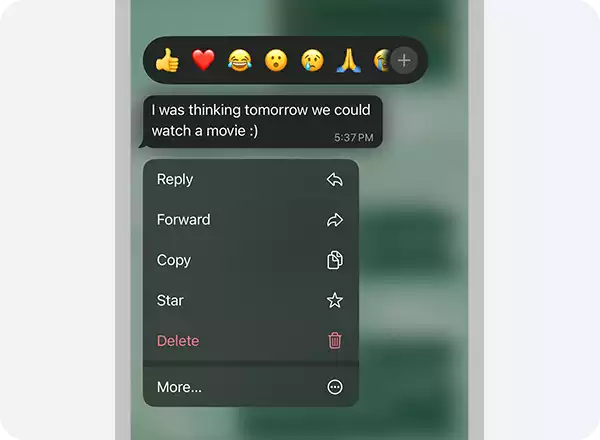
Pro tip: WhatsApp now offers playback at 1.5x or 2x speed. Helpful, yes, but still not ideal when the message feels like it could win an award for length.
Digital habits with a bigger impact
While a quick WhatsApp audio recording feels effortless, the environmental footprint is often overlooked. Audio files are significantly larger than text-based WhatsApp messages, meaning they generate more data traffic and more CO₂ emissions. They also take up extra storage space and eat into mobile data allowances.Recommended reading: To explore this topic further, our guides on sustainable digital habits and the carbon footprint of an email offer more insight.
Privacy matters, especially in public
Another drawback appears the moment you open WhatsApp in public without headphones. A personal voice note may contain sensitive or emotional updates, and everyone nearby can hear them if the volume isn’t muted. Fellow commuters probably won’t enjoy your cousin’s unexpected breakup announcement – or any family drama, for that matter.No time to listen? How to convert voice messages to text
There is a solution: transcription. You can now convert a spoken message into written text, making it easy to catch up on the contents of a WhatsApp voice message without disturbing anyone nearby. Perfect for finding out about the breakup quietly, and no headphones required!To use this feature, go to Settings > Chats > Voice message transcripts > Manually in the app. Then, back in the WhatsApp chat, simply press and hold the audio message and tap “Transcribe.” The app will generate a text version so you can read the message instead of waiting for the perfect moment to play it out loud.
How to record and send WhatsApp voice messages
Curious how to send a voice message on WhatsApp? When you open WhatsApp and enter any chat, you’ll find a small microphone icon at the bottom right of the text field.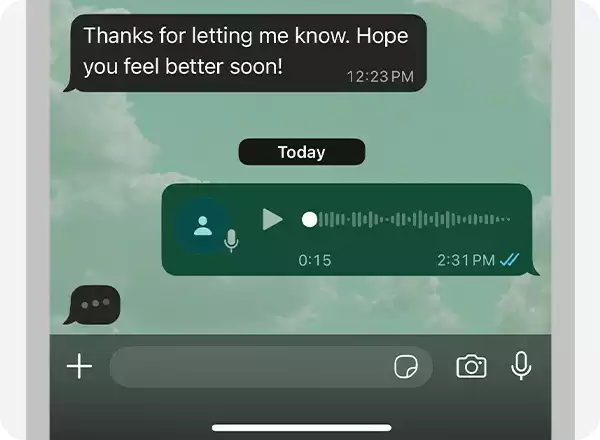
Press and hold the icon to start a WhatsApp voice recording. When you're finished, tap the green arrow to send the voice message, or use the trash can to delete it. A pause button appears while recording, making it easy to stop and continue.
If holding the button gets tiring, you can also lock the recording: hold the microphone and slide your finger upward toward the padlock. This creates a hands-free WhatsApp audio recording, ideal for longer notes.
There’s also a “view once” option for more private messages. If you want your WhatsApp audio to be played only once, tap the small “1” symbol above the send button. The voice note will disappear after a single listen, which is perfect for more sensitive information or one-time updates.
Conclusion: Are voice messages worth it?
Opinions on voice messages vary widely. Some people swear by them, others find them endlessly irritating, and for those contacts, a classic text message is usually the safer choice.For many, though, voice messages are a welcome chance to let thoughts wander freely. A quick update can easily turn into a mini-podcast, and that’s part of the charm. They’re also a handy way to keep friends and family in the loop without scheduling a long call or carving out an entire evening.
On the flip side, lengthy messages aren’t always easy to tackle during a busy day. Many people wait for a quiet moment, such as a commute on a bus or train (headphones recommended), to listen to them. And since no commuter wants surprise background drama, replies in public are typically typed rather than spoken.
In the end, deciding when and how to use voice messages is highly individual. For people who communicate frequently with one another, it can be helpful to agree on what works best: writing and reading, or speaking and listening.
If you found this article helpful, please leave us some feedback below. 😊 And if you still don’t have a mail.com email account, why not sign up for free today?
Images: 1&1
14 people found this article helpful.
Related articles